

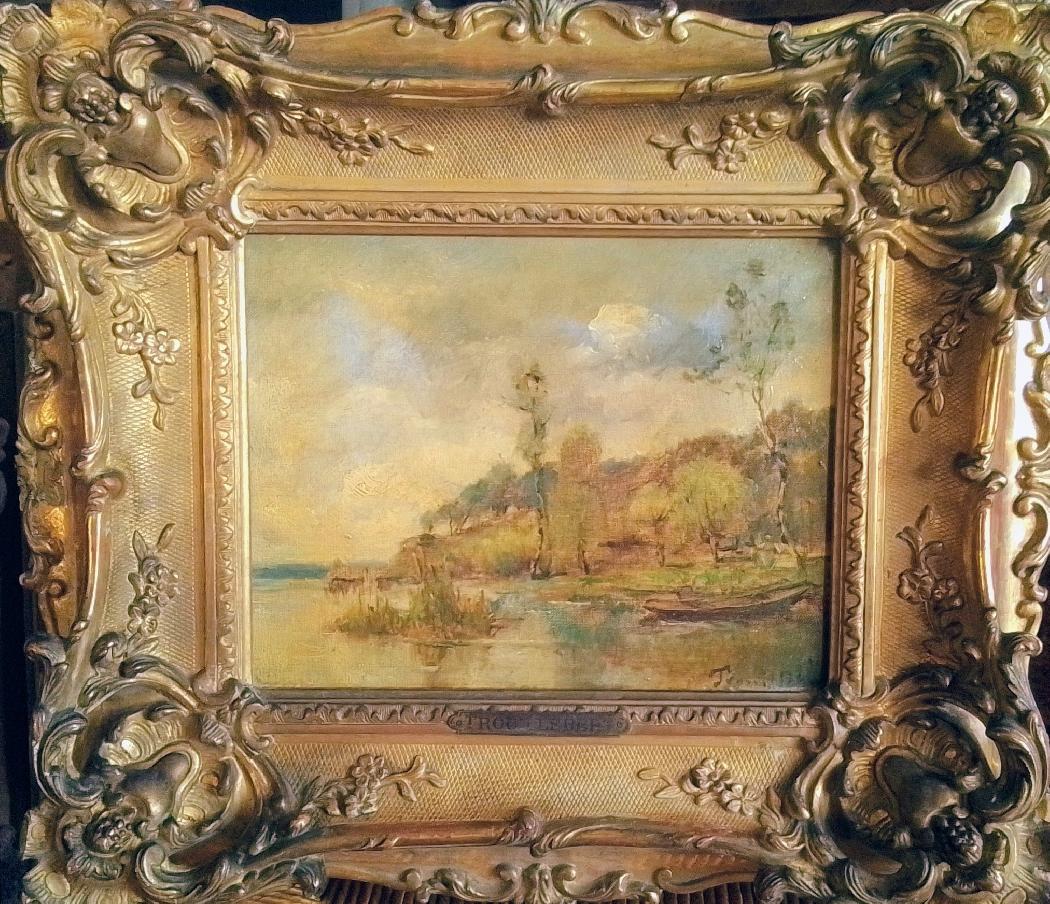
 Oil on canvasView the work
Paul Désiré TROUILLEBERT 1831+1900
Biography
Born in 1829 in Paris and died in 1900 in the same city, Paul-Désiré Trouillebert is a French painter. He learned painting at the École des Beaux-Arts in Paris and was particularly introduced to oil painting on canvas or panel. He trained in particular with the portraitist Ernest Hébert and joined the workshop of Charles-François Jalabert, a renowned portraitist. Attached to the Barbizon School, Trouillebert painted in the open air and studied nature. He also works in his workshops in Paris or Candes or on his boat workshop which allows him to travel on the rivers between Saint-Germain-sur-Vienne, Montsoreau and Candes. His production focuses on the rural landscapes he encounters around Vienne, Oise, Loire and also the Somme. He pays great attention to trees, animals but also to the crops of the surrounding fields and waterways, forming the heart of his work. In his early days, he painted nudes and genre scenes for which he was noted. His very luminous compositions are marked by the large place given to water, the sky and the atmospheric effects which impact the landscape. Skillfully constructed, his landscapes exploit effects of transparency, particularly characteristic of his work, which give the motifs a certain agitation. A particularly talented landscaper, Paul-Désiré Trouillebert enjoyed real success with his contemporaries. From the 1860s, he presented his paintings in various important Salons, such as the Salon des Artistes Français, but also with major French art dealers. His style is particularly appreciated for its combination of precision and lightness, its vaporous aspects and the great attention paid to the transcription of the light effects on the landscape during the day. His style is particularly close to his contemporary and friend, the landscaper Jean-Baptiste Camille Corot.
Works
Oil on canvasView the work