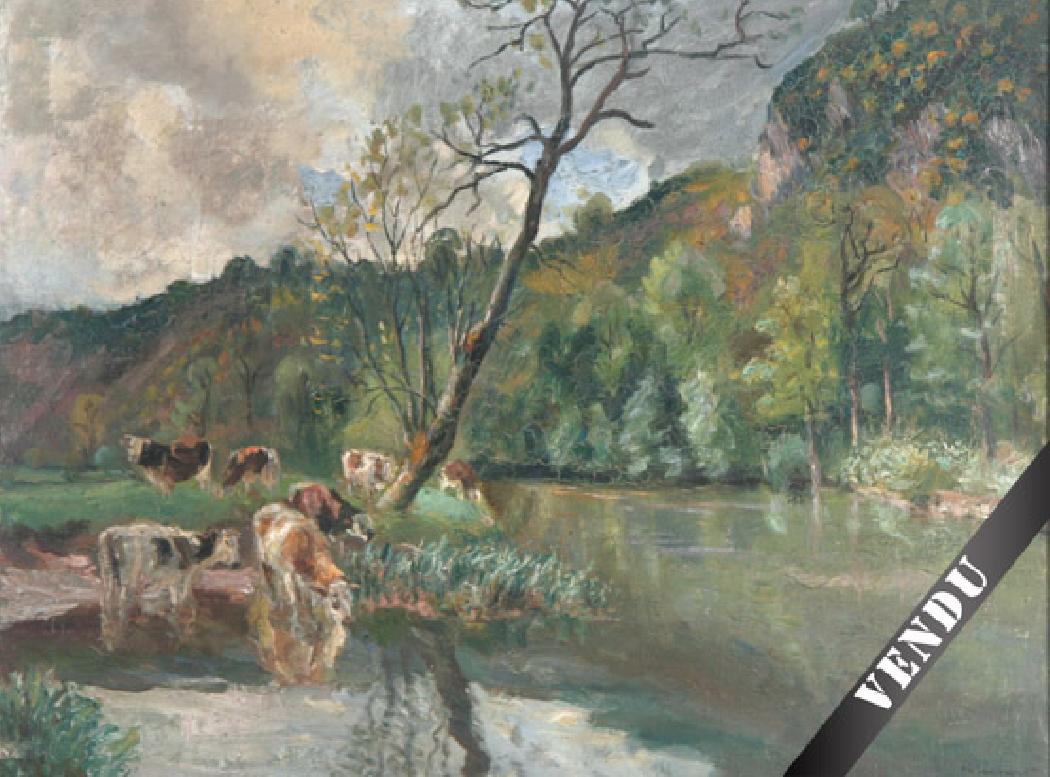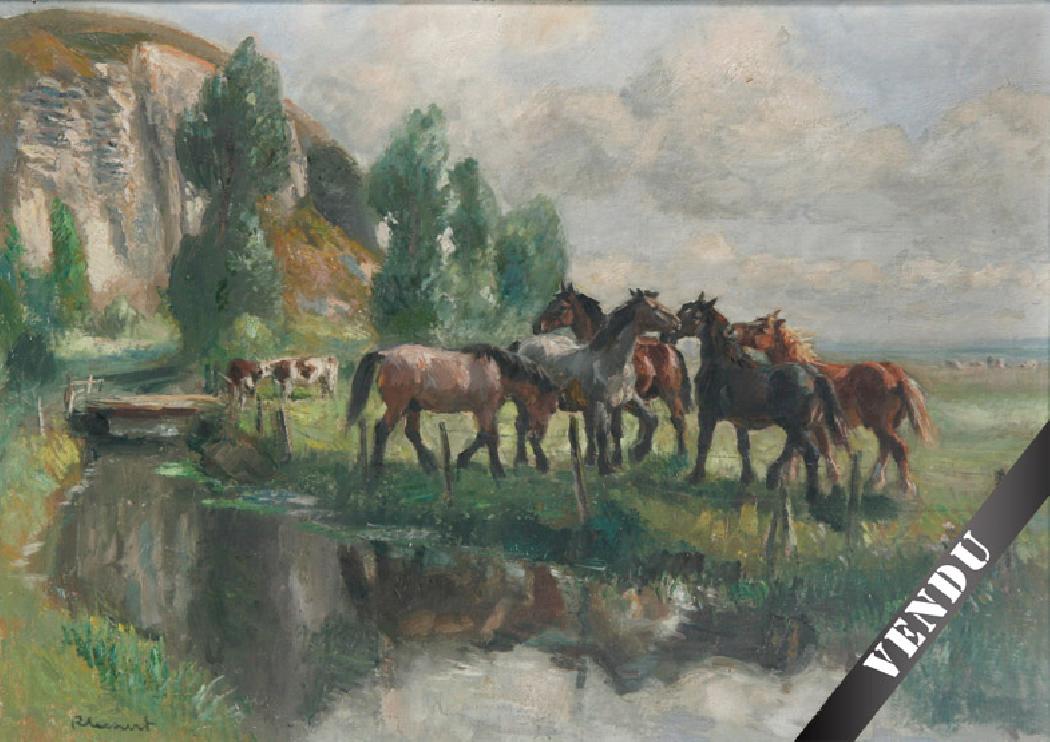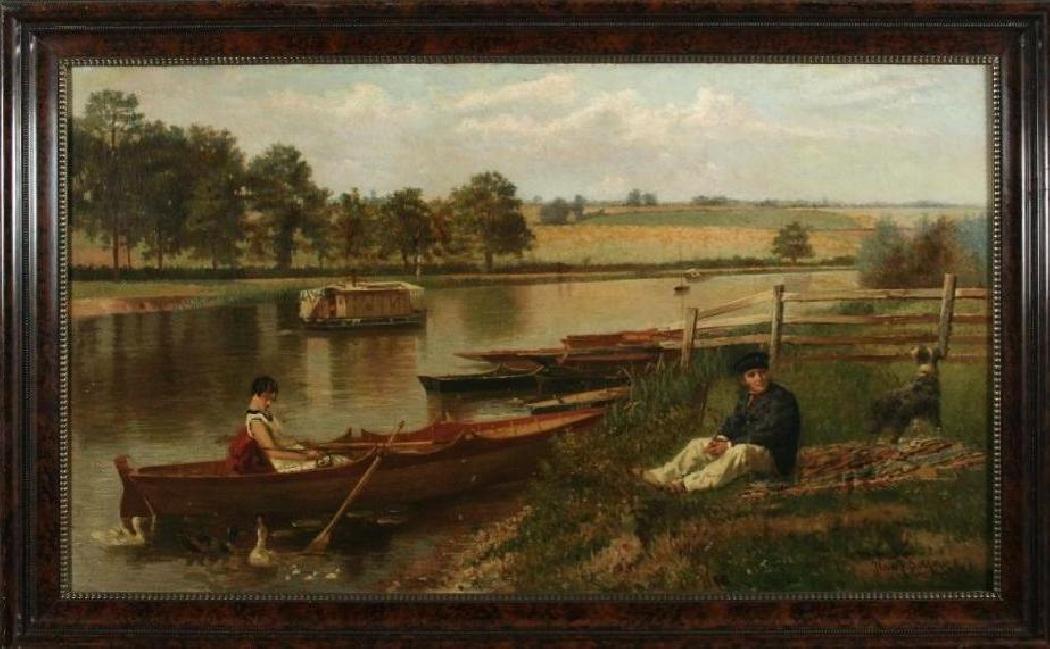
Other views
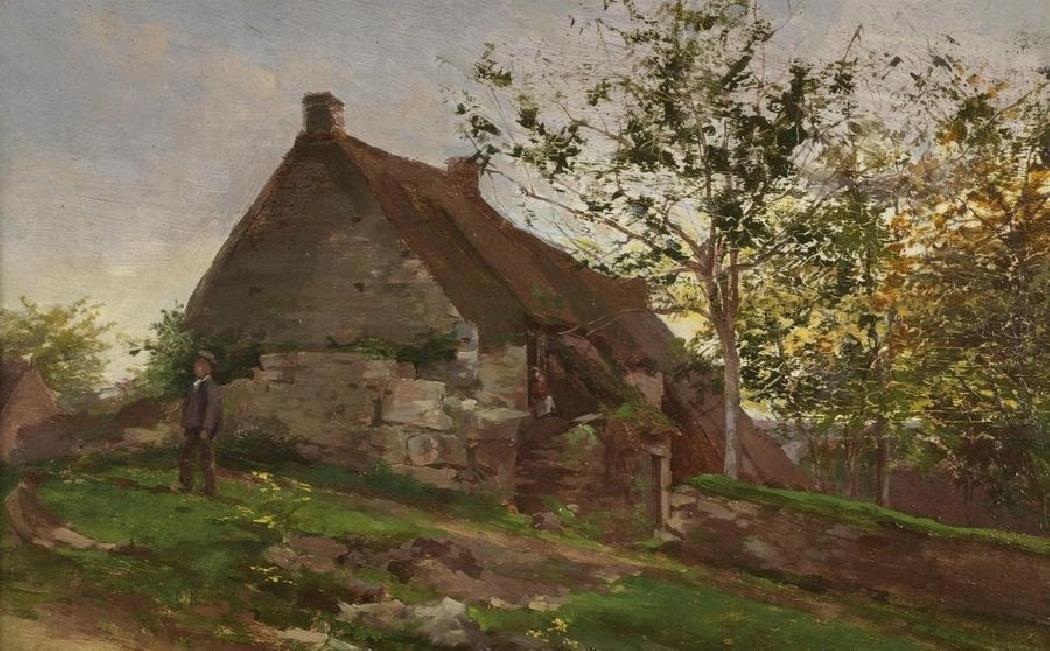
Cottage house in Nomandie. O/W. 19 X 30 cm
Hippolyte Camille DELPY 1842+1910| Type | Oil on panel |
|---|---|
| Signature | Unsigned |
| Size | 19 x 30 cm |
Price on request
Enquire about the price with the gallery. No online payment.


Other views
| Type | Oil on panel |
|---|---|
| Signature | Unsigned |
| Size | 19 x 30 cm |
Price on request
Enquire about the price with the gallery. No online payment.
Artist bio
Hippolyte Camille Delpy, born April 16, 1842 in Joigny (Yonne) and died June 5, 1910 in the 18th arrondissement of Paris, is a French painter.
Biography Hippolyte Camille Delpy comes from a fairly wealthy family from Joigny, in Burgundy. He was a student of Charles-François Daubigny from 1855 and was his regular student from 1858. During the summers, Delpy (close in age to Daubigny's son, Karl, also a painter) traveled with the Daubigny family. , making excursions aboard the workshop boat Le Botin. Thanks to Daubigny, Delpy meets Camille Corot who encourages and advises the young painter. In 1869, Delpy sent his first paintings to the Salon de la Société nationale des beaux-arts. In December 1869, he began painting snow scenes during a harsh winter.
A contemporary of the Impressionists, Delpy mixed the techniques learned from Daubigny with a livelier palette and a more vigorous touch, characteristic of the generation of painters of the Barbizon school.
In the early 1870s, Delpy often worked in Ville-d'Avray, Corot's favored site, and in Auvers-sur-Oise, where Daubigny lived, and where he married Louise-Berthe Cyboulle, daughter of a painter from flowers and insects, who died in 1885. Camille Delpy became friends with Camille Pissarro and Paul Cézanne, who shared his admiration for Daubigny.
His paintings presented at the Salons of 1873 and 1874 were well received. In 1875, he presented a snow scene at the Salon for the first time and received rave reviews from Jules-Antoine Castagnary.
In 1876, Delpy organized a sale of his works in Paris at the Hôtel Drouot. Announced in several newspapers, the sale was a significant success with 45 works sold. That summer, Delpy moved with his family to Bois-le-Roi, near the Fontainebleau forest.
At the Salon of 1880, Delpy presented a potato harvest scene, his first landscape with large figures. During the 1880s, he alternated between stays on the Normandy coast, in the forest of Fontainebleau and in Paris. He received his first Salon medal in 1884.
In 1886, Delpy traveled to the United States with a group of artists who painted a panorama of the Battle of Manassas (Civil War) in Washington. The same year, he became a member of the Society of French Artists. At the Universal Exhibition of 1889, Delpy received an honorable mention. Georges Petit, a leading Parisian gallery owner of contemporary French painting, began selling his paintings and organized several individual exhibitions for him.
In 1890, he married Marie-Cécile Lenormand, who died in January 1898. On November 16, 1900, he married Joséphine Péguy5.
In 1908, a Delpy exhibition was held at the Grafton Galleries in London.
Hippolyte Camille Delpy died on June 5, 1910 in Paris.
His son Henry-Jacques Delpy, born in Bois-le-Roi (Seine-et-Marne) in 1877 and died in 1957, is also a landscape painter6.
The painter Lucien-Victor Delpy (1898-1967) is a distant cousin.
Works in public collections Béziers, museum of fine arts:
The Grande rue in Auvers-sur-Oise4; The Court of Mother Labaume in Bois-le-Roi.
Louviers, Louviers museum: Fontainebleau Forest.
Paris, Carnavalet museum: Snow in Montmartre.
Rooms
Customize