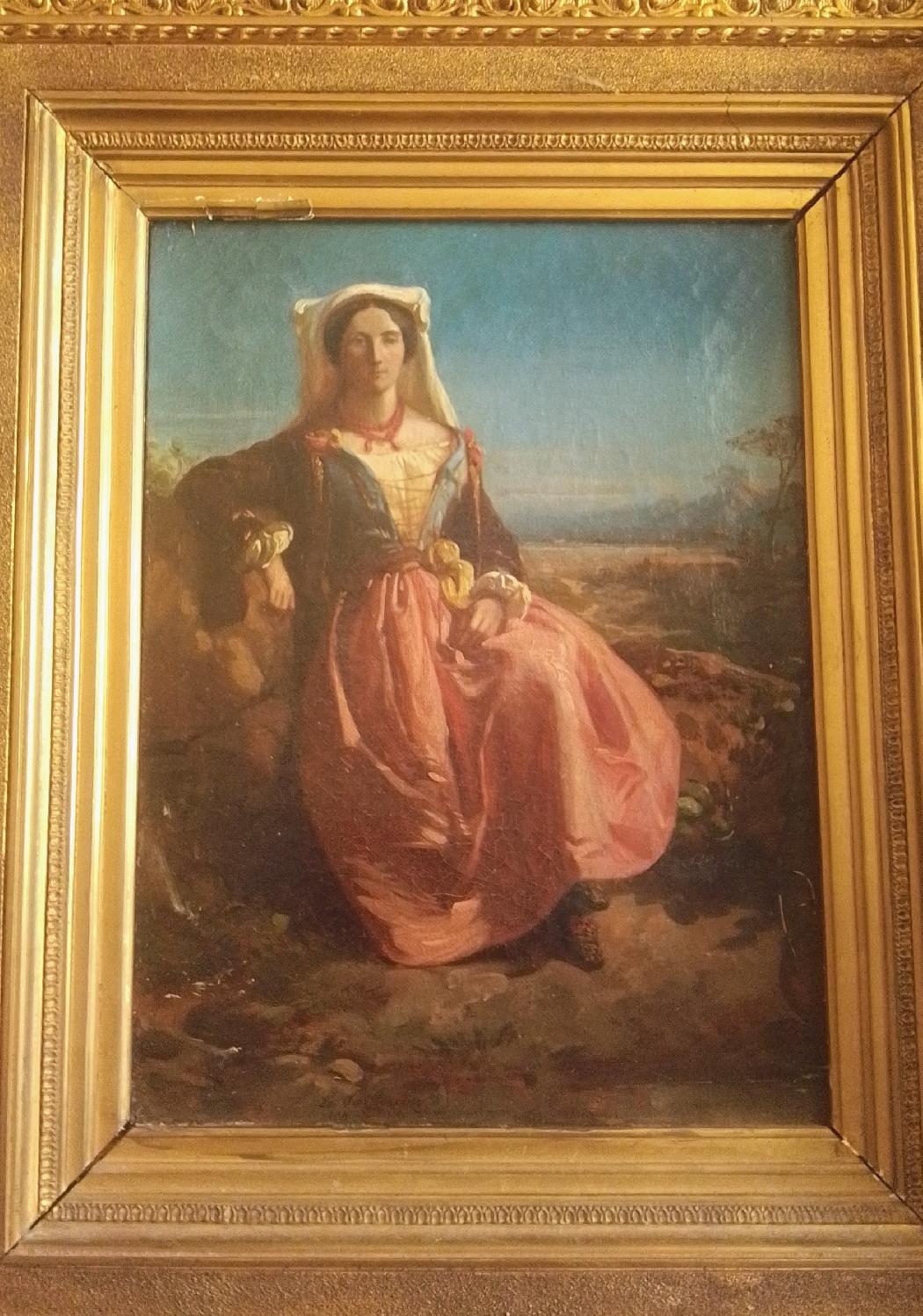


 Oil on canvasView the work
Eugène Modeste LEPOITTEVIN 1806+1870
Biography
Eugène Modeste Edmond Poittevin was born in Paris, in the 1st arrondissement, at 8 rue de Ventadour in the parental home. His father, Nicolas Jean Baptiste Modeste Poittevin, of Rouen origin, was a cabinetmaker and assistant furniture upholsterer, then head cabinetmaker at the Palace of Versailles, Versailles where the family settled. A mediocre student and artist at heart, Eugène Le Poittevin became the student of a local painter Ledoux. At the age of 15, to prove his vocation to his father who was opposed to it, he made a copy at the Palace of Versailles of the painting The Sack of the City by Nicolas Antoine Taunay. The copy caused a sensation in the city of Versailles, the Duchess of Berry granted the young man a pension of 500 francs from the fortune of King Louis XVIII. He attended Xavier Leprince's workshop for a short time; the latter had a short career since the public only saw about twenty paintings by the artist which he presented during the Salons of 1819, 1822 and 1824. Le Poittevin would nevertheless have borrowed from him his taste for anecdotal and picturesque. Under the influence of Leprince, Eugène Le Poittevin traveled to Normandy, Brittany, Landes, Italy, Belgium, the Netherlands, Germany and England (London).
In 1826, when Xavier Leprince died, Le Poittevin managed to be admitted to the School of Fine Arts in Paris, in the studio of Louis Hersent, where Karl Girardet and Augustin Pajou also trained. Twice, he tried unsuccessfully in the Grand Prix de Rome competition.
He moved into the workshop of his master Leprince after his death and participated in the Salon with three works under the name Potdevin, with success.
His father changed his name and was called Le Poittevin, and was appointed to the Château des Rohan near Strasbourg. In 1829, Eugène Le Poittevin won second prize in the Rome Grand Prix4 competition, considered too young for first prize. His master Hersent recommended that he work from nature. He exhibited successfully at the Salons from 1831 until his death in 1870.
The debut at the Salons When Leprince died prematurely in December 1826, Le Poittevin would have completed one of the large compositions he planned to exhibit at the Salon of 1827: a view of his studio begun last year5. Poittevin would thus have completed this painting by creating 11 of the 36 portraits present in this composition. While the painting was presented at the Salon of 1827 under the title Interior of the studio of the late Leprince, the Salon booklet reveals the involvement of the young painter Le Poittevin, designated under the name of Eugène Potdevin6. This is Le Poittevin's first participation in the Salon. At the same Salon he presented three works by him: Des Moissonneurs (which was acquired by the Duchess of Berry to be exhibited in her gallery), A Farm Door and View taken between Saint-Germain and Versailles. This last painting was acquired by the collector Du Sommerard7 who also bought the Interior of the studio of the late Leprince completed by Le Poittevin.
The second exhibition of his paintings at the Salon of 1831 constituted his first coup. This time he presented himself there under the name of Lepoittevin and exhibited nine paintings. These are picturesque landscapes animated with figures, climatic views, rural motifs and seascapes whose titles have this particularity, which Le Poittevin will frequently use, of revealing a precise location of the place represented: English mill located on the edge of the sea / Interior of a courtyard, taken in Normandy / Interior of a stable, taken in a brewery in London / View taken on the banks of the Thames / Souvenir of the banks of the Thames / A marine, View taken near Calais (acquired by Alexandre Du Sommerard) / An effect after the rain, near Versailles / View of an old wooden bridge, taken in Normandy / A beached sloop, view taken on the coast of England, at low tide. During this Salon of 1831, his marine View taken on the banks of the Thames earned him a 2nd class medal. He distinguished himself at the following Salons since he obtained an honorable mention at the Salon of 1833 and that of the Salon of 1834, while in 1836, it was the exhibition of another navy, Pêcheurs normands, which gave him this time earned a 1st class medal.
From 1836, he exhibited at the Brussels Salon; that year, he presented three paintings: a Rescue of debris / Scene of Norman fishermen, at low tide / Defense of a coast. He received a silver medal at the end of this Salon. This recognition by Belgium perhaps led him to direct his career strategy towards Belgium since during the Bruges Salon of 1837, he is referenced there as being domiciled in Brussels. Surprisingly, in 1837, he appeared in the French press as a member of the Academy of Fine Arts in Brussels.
In France, moreover, official recognition came quickly; it came to fruition during his breakthrough at the Salon of 1843 which earned him the Cross of theThe caricatures of 1830 He supplied lithographic plates to the newspaper La Caricature by Charles Philipon, and launched the fashion, in the tradition of Daumier and Ramelet9, of Diableries of lithographs, caricature collections, such as Le Diable fecit or Diabolico Foutromanie (collection of 12 plates), Charges and diabolical discharges, L'Enfer en goguette, burlesque and pornographic scenes which were immediately censored then condemned to destruction in 1845 for violating good morals10.
Print Eugène Lepoittevin produced lithographs, inventing, among other things, scenes of devilry and operettas from 1832 which enjoyed a certain success. Subsequently, the sea and sea bathing became his favorite subject (Salons of 1839 and 1840). Among its publishers of boards, we count Goupil & Cie. In 1858, he composed, something rare, a color lithograph, entitled Fisherman bringing back his catch11.
Diabolical Charges and Discharges, 1907, album.
Orders for Versailles The Shipwrecked (1839), Amiens, Musée de Picardie.
Naval battle won off the island of Embro, 1346 (1849), Versailles, French History Museum.
In 1834, the government of Louis-Philippe commissioned the Combat of Wertingen of October 8, 1805 for the historical museum of Versailles, then in 1835 the Naval Battle won before the island of Embro, 1346.
His work The Attack of the White Bears was purchased by the State and presented to the Luxembourg Museum. In 1840, he traveled to Algeria and returned ill. On his return, he exhibited Sea Beggars, View from the banks of the Thames and Sunset at the Rouen salon. He received orders for the historical museum of Versailles from The Prize of Baruth on May 17, 1109 and Lunch offered to Queen Victoria under the tent at Mont d'Orléans, in the Forest of Eu.
Success in Prussia and Belgium He traveled and exhibited regularly in Berlin from 1839, then in Belgium. In 1841, he exhibited in Leipzig, Dresden. It was therefore promoted by the Prussian merchant Louis Sachse (de), a pioneer of the art market. His classes welcomed many German students in Paris. He is a member of the academies of Antwerp and Berlin.
He was named knight of the Legion of Honor in Paris in 1843 and knight of the order of Leopold in Brussels in 1845.
He married Stéphanie Maillard (born in 1825) with whom he had his first daughter Eugenie the following year, in 1846. The name change to Le Poittevin was then made. In 1847 his daughter Marie was born.
In 1848, Le Poittevin was a member of the committee responsible for developing organizational projects and ensuring the interests of art and artists.
In 1849, he was appointed official painter of the Navy.
Genre scenes View of the base of the needle at low tide (1860), Fécamp, Fisheries Museum.
Salon of 1861, photograph by Pierre-Ambroise Richebourg, 3 paintings by Poittevin hanging below including the View of the base of the needle at low tide on the left.
His wife died in 1851. At that time, he built a villa, La Chaufferette, in Étretat, as well as a workshop on the seafront where he stayed regularly. The theme of the sea, fishermen and their families, with whom he maintained cordial relations, became central in his work (View of the base of the needle at low tide, 1860, Fécamp, Musée des Pêcheries). Themes that he presented at the Salon and which were lithographed by Jean-Pierre-Marie Jazet for Goupil et Cie (La Vie d'une caique). He paints sea bathing scenes, Les Bains de Mer in Étretat (Museum of Fine Arts of Troyes). At the Universal Exhibition of 1867 in Paris, he sent his painting Sea Baths, Beach of Étretat, acquired by Napoleon III for the Élysée Palace. His Shipwreck in the Polar Seas was presented at the Le Havre Maritime Exhibition in 1869.
That same year, he lent his studio in Étretat to Gustave Courbet who came there to paint his famous Cliff of Aval After the Rain and his series The Wave.
At the same time, Le Poittevin, who does not lack humor, paints Cinderellas, Little Red Riding Hood or Suzanne and the Old Men (Saint Petersburg, Hermitage Museum) where two friends of the artist are caricatured watching a Norman bathing.
In 1870, although seriously ill, he presented his last painting at the Salon, View of the surroundings of Étretat during the bathing season. He died at the home of his daughter Eugénie on August 6, 1870.
His second wife Adèle Pironin, whom he married in 1861, died in 1872.
Le Poittevin's studio, including 144 paintings, thousands of drawings and his collections, was sold in Paris at the Hôtel Drouot from April 9 to 12, 1872.
Style His genre scenes are inspired by that of Eugène Isabey, who introduced him to Étretat, and by Dutch painting, which he studied during a stay in the Netherlands. He works regularly with his friends such as Hippolyte Bellangé, Émile-Henri Brunner-Lacoste, Charles Mozin.
His taste for realism links him to the young school of 1830, while remaining faithful to the m
Works