

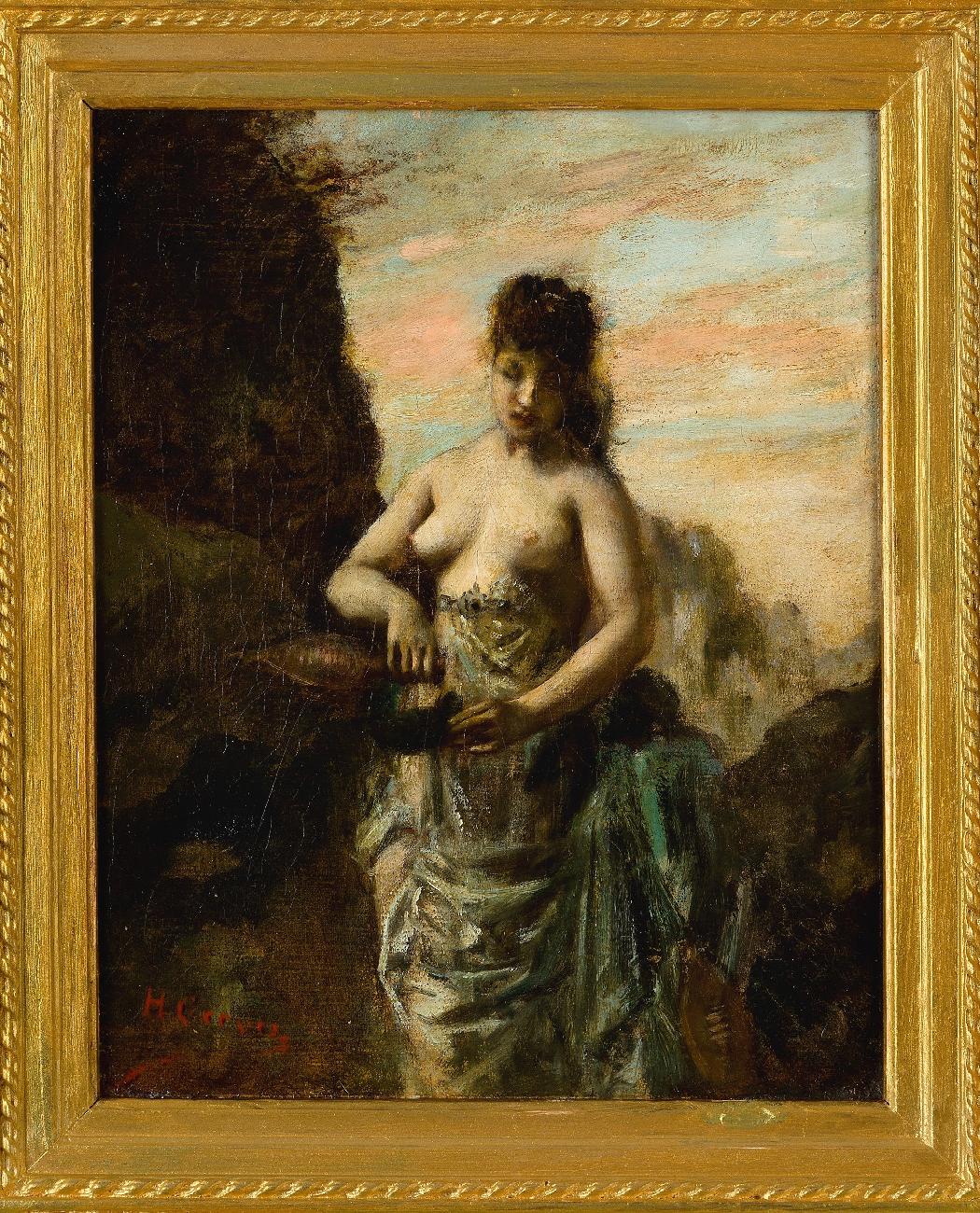
 Oil on canvasView the work
Henry GERVEX 1852+1929
Biography
Henri Gervex was the son of Joséphine Peltier and Félix Nicolas Gervex, a piano maker. A family friend had him admitted to the studio of the painter Pierre-Nicolas Brisset in 1867.
Three years later, he joined the 152nd battalion of the National Guard. In 1871, he was accepted into the École des Beaux-Arts in Paris in the studio of Alexandre Cabanel, where he studied for five years as a fellow student of Jean-Louis Forain, Fernand Cormon and Eugène Damas.
He also apprenticed with the orientalist painter Eugène Fromentin.
The beginnings Gervex made his debut at the 1873 Salon by exhibiting a Sleeping Bather. The following year, he received a second-class medal for his Satyr Playing with a Maenad, whose nude is influenced by Cabanel's style, and was purchased by the State for the Musée du Luxembourg.
In 1876, he met Édouard Manet and frequented the Impressionist painters. His painting was influenced by them and he lightened his palette.
The Rolla scandal In 1878, he caused a scandal by exhibiting Rolla, considered his masterpiece.
Rolla (1878), Musée des Beaux-Arts in Bordeaux.
This painting, inspired by a poem by Alfred de Musset, was rejected by the jury of the Salon for the same reasons as Manet's Olympia: representing a prosaic nude in a contemporary setting, the work was deemed immoral.
It was exhibited in a gallery, at the art dealer Bague at 41, rue de la Chaussée-d'Antin, where the crowds gathered. He had the satisfaction, shortly before his death in 1929, of seeing it enter the Musée du Luxembourg.
He also painted the portrait of Mlle Valtesse de La Bigne, a demi-mondaine who posed as a model and who inspired Émile Zola to create the heroine of his novel Nana.
Gervex himself was one of the models for the character of Fagerolles, an opportunistic and socialite painter, in the novel L’Œuvre de Zola, published in 1863.
In the 1880s, he traveled to Spain. He was a member of the Cercle des mirlitons chaired by Ernest Meissonier, and exhibited at the Cercle artistique de la Seine, which had just been created. From that year onwards, he made numerous stays in Dieppe with the parents of Jacques-Émile Blanche.
In 1882, he made his first trip to England with Auguste Rodin. He worked on the decoration of the town hall of the 19th arrondissement of Paris. The following year, he made his second trip to England with Rodin and was named a knight of the Order of Leopold of Belgium on the occasion of the Triennial Exhibition of Fine Arts in Ghent.
In 1884, at the end of his third trip to England, he moved into a new studio on Rue de la Chaussée-d'Antin. He travelled to Italy with Guy de Maupassant and G. Legrand.
He founded a painting academy with the painter Ferdinand Humbert, taking over the Atelier Cormon.
A recognised artist In 1889, Henri Gervex was promoted to officer of the Legion of Honour. In 1890, he was named a knight of the Order of Saint Olaf by the King of Norway and Sweden. In 1891, he took part in the International Exhibition of Fine Arts in Munich. In 1892, he was appointed Officer of the Order of Saint Michael by the Bavarian Government.
On February 9, 1893, he married Henriette Marie Marguerite Fauche (1868-1958), a young girl from the Protestant upper middle class, who was a student of Charles Chaplin. He was appointed Knight of the Order of Charles III of Spain. On December 18, 1894, their daughter Colette (1894-1976) was born, who married Count René Henri Louis du Plessis d'Argentré in 1920.
In 1895, he was appointed Vice-President of the Examination Committee of the National Society of Fine Arts. He decorated the physics room at the Sorbonne in Paris.
In 1896, during his first trip to Russia, he was appointed Commander of the Order of Saint Anne of Russia. In 1897, he took a cruise to Italy and then to Turkey. In 1898, he made a second trip to Russia. He sent The Coronation of Nicholas II to the 1900 World's Fair. The same year, he participated in the decoration of the Salle Dorée of the Le Train Bleu restaurant at the Gare de Lyon in Paris with The Battle of Flowers in Nice.
He made frequent stays in Deauville and Trouville where he lived at the villa Les Frémonts sur la falaise, which belonged to Mrs Finaly, where Marcel Proust visited him several times.
In 1901, he left with his family for a third trip to Russia. In 1902, he took a cruise to Italy. In 1911, he was promoted to Commander of the Legion of Honour and received the commission to decorate the ceiling of the main staircase of the Court of Auditors in Paris.
In 1913, he joined the Institut de France and was elected president of the Société des pastellistes An ambulance in Poitiers (1914), Nanterre, La Contemporaine.
The Blessing of the Pope (1916), Nanterre, La Contemporaine.
During the First World War, Henri Gervex was too old to be mobilized. He then created small works on wood or canvas illustrating the daily life of the war and which were reproduced in the illustrated press such as Le Gaulois, L'Illustration or Herald Tribune. In An ambulance in Poitiers (also known as The Ambulance of the Poitiers Station in the press), Gervex depicts nurses caring for soldiers and thus highlights their difficult working conditions during the war. He also created The Train of the Wounded, published in the newspaper L'Illustration: "This painting was seen by most of France, which will not have had any other vision of the cruelties of war. (...) While the most seriously injured rested on bunks or stretchers, those whom the senior doctors had been able to classify as "seated wounded" traveled in wagons filled with straw and showed at each stop in the stations that they had lost none of their courage or their appetite. It was at this time that the painter Gervex painted this scene that everyone could see in the small provincial stations, as well as in the large regulating stations"6. The artist also produced drawings, gouaches or watercolors imbued with patriotism for newspapers such as La Messe en forêt d'Argonne, Le Salut du poilu, La Double Moisson or L'Esplanade des Invalides. In 1916, Henri Gervex painted La Bénédiction du pope, a propaganda painting in which Russian soldiers in a trench are blessed by a priest. This official painting depicts the spiritual authority (the priest) and the heroic officer (the wounded soldier). To create this work, the artist was inspired by a previous painting Icebreakers on the Neva, executed during a trip to Russia. 8 In addition to painting the reality of war, Henri Gervex was part of several associations helping soldiers and was also a donor for a raffle for the Œuvre du Soldat dans les tremblants at the Bernheim gallery. In 1918, he received the Croix de Guerre for services rendered to the fatherland. In 1919, the painter participated in an exhibition at the Palais des Champs-Élysées held to benefit war works and organized by the Société des artistes français and the Société nationale des beaux-arts. In 1925, he was elected associate member of the painting section of the Royal Academy of Sciences, Letters and Fine Arts of Brussels. He owned a private mansion in Paris on the edge of Parc Monceau, whose yellow curtains from his daughter's bedroom are often reproduced in his paintings.
In 1928, he was struck down by an eye disease. He died in Paris on June 6, 1929 at 12, rue Roussel (now rue Léon-Jost), he is buried in the 55th division of the Père-Lachaise cemetery10,11.
Tribute Opened in 1932 on the site of bastions no. 46 and 47 of the Thiers enclosure, rue Gervex pays tribute to him in the 17th arrondissement of Paris.
Works in public collections Satyr playing with a bacchante (1874), Paris, Musée d'Orsay.
Café scene in Paris (1877), Detroit Institute of Arts.
Retour de bal (circa 1879), location unknown.
Allegory of Justice (1910), Paris, ceiling of the Palais Cambon.
United States Detroit, Detroit Institute of Arts: Café Scene in Paris, 1877, oil on canvas, 100.6 × 135.9 cm.
Philadelphia, Philadelphia Museum of Art: Portrait of Louis Pasteur, 1923, lithograph, 5.7 × 3.8 cm.
Washington, National Gallery of Art: Study for an “Autopsy at the Hôtel-Dieu,” 1876, oil on canvas, 53.3 × 43.2 cm.
France Angers, Musée des Beaux-Arts: Diana and Endymion, 1875, oil on canvas, 257 × 151 cm.
Bayonne, Musée Bonnat-Helleu: Study of a Nude Woman, oil on canvas, 23 × 14 cm.
Beaune, Museum of Fine Arts: Autumn Morning or Edge of the Forest of Fontainebleau, oil on canvas, 54 × 40.5 cm.
Bordeaux, Museum of Fine Arts:
Study of the Back of an Old Man, oil on canvas, 98 × 76.4 cm; Rolla (1878), oil on canvas, 176.2 × 221.3 cm.
The Mirror (around 1880), oil on canvas, 65 x 54 cm.
Chambéry, Museum of Fine Arts:
View of a Beach, Deauville, oil on canvas, 32.3 × 46 cm; Descent from the Cross, oil on canvas, 61.6 × 40 cm; Portrait of Madame Gervex, 1893, oil on canvas, 230 × 132 cm.
Dieppe, Dieppe Castle: Portrait of Doctor Émile Blanche, oil on canvas.
Dijon, Museum of Fine Arts: Communion in the Church of the Trinity, 1876, oil on canvas.
Évreux, Museum of Évreux: Sleeping Woman, circa 1878, oil on canvas, 32.2 × 40.3 cm.
Gray, Baron-Martin Museum: The Family Album, 1895, oil on canvas, 95 × 170 cm.
La Rochelle, Museum of Fine Arts: Sleeping Bather, 1873, oil on canvas.
Lille, Palace of Fine Arts:
Figure of a Nude Woman, Standing, Hands Behind Her Head, Black Chalk on Paper, 23.5 × 21.7 cm; Musée d'Orsay :
Portait de Charle Émile Van Marcke, vers 1870, crayon sur papier 17,2 × 16 cm ; Paysage marin (Dieppe), vers 1885, pastel sur papier, 47 × 59,5 cm; Satyre jouant avec une bacchante, 1874, huile sur toile, 159 × 193 cm; Une séance du jury de peinture au Salon des artistes français, 1885, huile sur toile, 299 × 419 cm Le Docteur Péan enseignant à l'hôpital Saint-Louis sa découverte du pincement des vaisseaux, ou Avant l'opération, 1887, huile sur toile, 242 × 188 cm; Portrait de Mademoiselle Valtesse de La Bigne, 1887, huile sur toile, 200 × 122 cm; Portrait de Mlle Valtesse de La Bigne (1879), Paris, musée d'Orsay.
À La République française, 1890, huile sur toile, 145 × 217 cm; Le Couronnement de Nicolas II et de l'impératrice Alexandra Féodorowna en l'église de l'Assomption de Moscou, 1896, huile sur toile, 115,5 × 151 cm.
Palais Cambon, Cour des comptes : Allégorie de la Justice, 1910, plafond de l'escalier d'honneur.
Palais de l'Élysée : La France accueillant l'Abondance, 1907, plafond.
Petit Palais : La Naissance de Vénus, 1907, huile sur toile, 146 × 200 cm.
Sorbonne, amphithéâtre Lefebvre53 : L'Arc en ciel, 1896, huile sur panneau.
L'Arc en ciel (1896), Paris, Sorbonne, amphithéâtre Lefebvre.
Théâtre national de l'Opéra-Comique, grand foyer :
Le Ballet comique de la Reine, 1897, huile sur panneau ; La Foire de la Saint Laurent, huile sur panneau.
Pau, musée des Beaux-Arts : Échaudoir, 1879, huile sur toile, 55 × 46 cm Reims, musée des Beaux-Arts : L'Attente trompée, 1890, huile sur toile, 51,3 × 44,6 cm Saint-Quentin, musée Antoine-Lécuyer : Portrait présumé de William Busnach, vers 1880, pastel sur papier, 71 × 51 cm.
Strasbourg, musée d'Art moderne et contemporain : Portrait de Gustave Schlumberger, 1887, huile sur toile, 24,2 × 19 cm Versailles, musée de l'Histoire de France : Distribution des récompenses aux exposants par le Président Sadi Carnot, à la suite de l'Exposition de 1889, le 29 septembre 1889 au palais de l'Industrie, le défilé des colonies françaises, 1897, huile sur toile, 615 × 982 cm.
Vizille, musée de la Révolution française : Rouget de Lisle et soldats de la République, 1887, huile sur toile, 120 × 140 cm.
Taiwan :
Église de la Trinité, 1899, huile sur toile, 190 x 84,5 cm, Tainan, Chimei Museum
Works
Oil on canvasView the work