


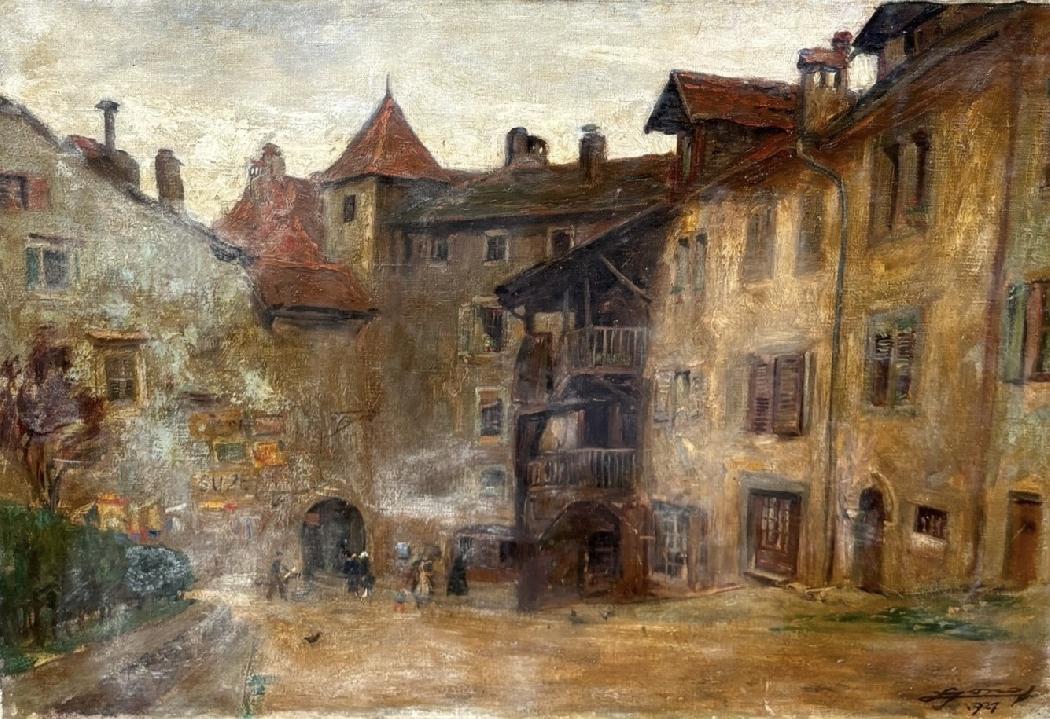
 Oil on canvasView the work
Lucien JONAS (1880 - 1947)
Biography
Lucien Jonas, a French painter, was born in Anzin, near Valenciennes (Nord), on 8 April 1880 and died in Paris on 20 September 1947.
The son of a northern industrialist who had founded an essential-oil distillery, Lucien Jonas received a classical education at the lycée in Valenciennes, studied music theory and the violin for seven years at the Valenciennes Conservatoire and passed his baccalauréat in 1898. After a year at the Valenciennes academies, he enrolled at the École des Beaux-Arts in Paris.
He became a member of the Société des Artistes Français in 1901, then worked in the studio of Albert Maignan and met Harpignies, who regarded him as his protégé.
He won several prizes, including the second Prix de Rome in 1905 and a gold medal in 1907.
In 1908 he married Suzanne Bedorez, with whom he had three children: Pierre, Solange and Jacques. The family lived in Paris.
In 1911 he received the Prix National of the Conseil Supérieur des Beaux-Arts for his painting La Consultation. In 1915 he became "military painter attached to the Musée de l'Armée", and in 1916 official painter to the Navy. The war inspired many drawings and portraits, as did the life of the miners.
He produced numerous successful Art Deco mural decorations for buildings in Paris (Maison des Centraux) and Valenciennes (Hôtel de Ville, Chamber of Commerce).
Made a Knight of the Legion of Honour in 1929, he was appointed Painter to the Air Force in 1932 and in 1933 worked with the Banque de France on the design of banknotes.
In 1937 he produced decorations for the Exposition Universelle in Paris, then created an important cartoon for the Gobelins Manufactory in Paris, "Le Travail pour la France". At the 1945 Salon des Artistes Français he received the Medal of Honour for painting for "Furor Teutonicus", a 14-metre fresco with some 120 figures.
Ill in 1946 and 1947, he painted a few open-air scenes at La Flèche, at the home of his parents-in-law, before returning to Paris, where he died on 20 September 1947.
Much of his work in Valenciennes was destroyed when the town was bombed in 1940. However, in the 2000s the artist's son, Jacques Jonas, gave the Valenciennes museum around a hundred sketches for his mural and ceiling decorations.
The Musée Carnavalet in Paris devoted a temporary exhibition to him in 2003, followed by the Musée des Beaux-Arts de Valenciennes in 2006.
Throughout his life, Lucien Jonas paid tribute to Valenciennes and its region, to the town's artistic past and to its people: a multitude of faces, trades, characters and physiognomies, always drawn and painted in a very lively way, with their traits and foibles but without malice.
An outstanding draughtsman, a virtuoso portraitist and a talented witness of his time, he sketched a veritable Comédie Humaine: luminous beach scenes; views of Paris, Annecy, Aix-les-Bains, Nice and La Flèche; portraits of magistrates, generals and ordinary soldiers; and his famous paintings of miners, one of which was chosen for a commemorative stamp marking the centenary of the Courrières mining disaster (1906–2006).
Works
Oil on canvasView the work