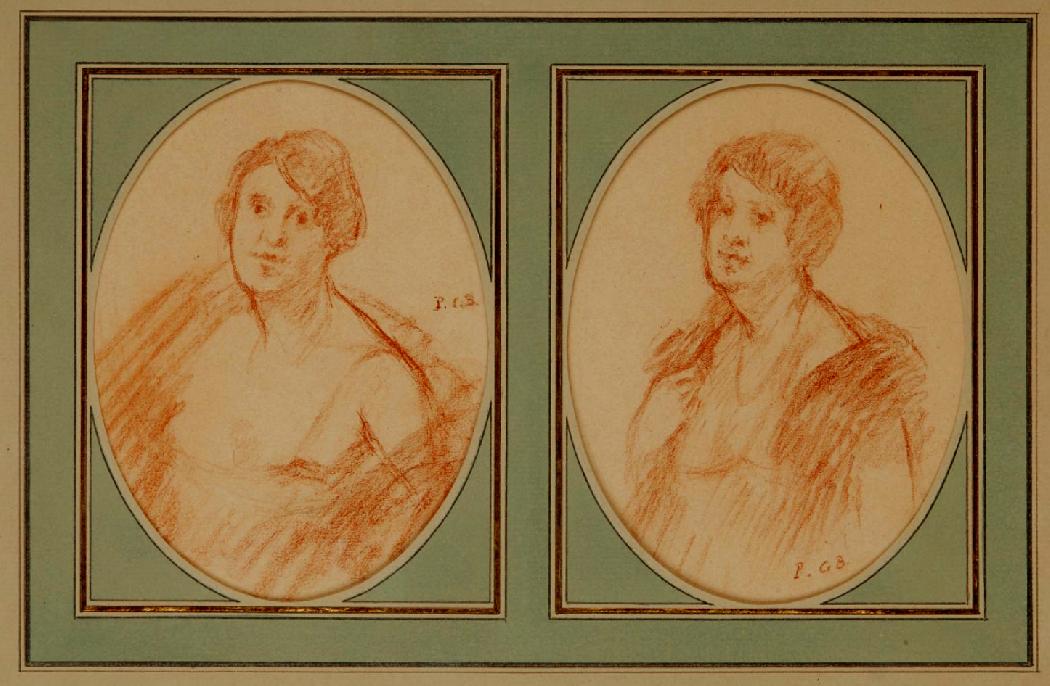
Vintage wall decor, portrait of an elegant - sanguine - 45 X 28 cm
Albert Ernest CARRIERE BELLEUSE 1824+1887| Type | Sanguine on paper |
|---|---|
| Signature | Lower right |
| Size | 45 x 28 cm |
Price on request
Enquire about the price with the gallery. No online payment.


| Type | Sanguine on paper |
|---|---|
| Signature | Lower right |
| Size | 45 x 28 cm |
Price on request
Enquire about the price with the gallery. No online payment.
Artist bio
Albert-Ernest Carrier de Belleuse known as Carrier-Belleuse, born in Anizy-le-Château on June 12, 1824 and died in Sèvres on June 3, 1887, is a French sculptor.
He was one of the most prolific artists of the century and enjoyed the greatest success during the Second Empire, benefiting from the personal support of Napoleon III1. His work was greatly influenced by the style of the Italian Renaissance and that of the 18th century, which he helped to bring up to date.
Carrier-Belleuse made a strong contribution to the improvement of decorative and industrial arts. From his workshop no. 15 rue de la Tour d'Auvergne in Paris, in which a large number of artists worked, including Auguste Rodin, came a prodigious quantity of decorative statuettes.
Carrier-Belleuse was, towards the end of his life, director of art works at the Manufacture de Sèvres. His passage was marked by the renewal of the collections and the modernization of the style.
His sons Louis Robert and Pierre Carrier-Belleuse also distinguished themselves in the field of the arts.
Biography The beginnings (1824-1855) Son of Louis-Joseph-François Carrier de Belleuse, notary, and Louise-Françoise-Eulalie Eudelinne, Albert-Ernest Carrier de Belleuse was born on June 12, 1824 in Anizy-le-Château, in Aisne. His father died in 1834, leaving the family in a precarious situation. The brothers François and Étienne Arago, cousins of the family, then took charge of his education. In 1837, the young Carrier-Belleuse entered into an apprenticeship in the workshop of the engraver Bauchery. Shortly after, he was admitted to the goldsmith Jacques Henri Fauconnier (1776-1839).
Through François Arago, he met the sculptor David d'Angers who facilitated his admission to the School of Fine Arts. Carrier-Belleuse entered there on April 1, 1840. Noted for his skill by the great bronze houses of Paris such as Barbedienne and Denière, it did not take long for him to receive numerous orders for models for candelabras, clocks, fireplace fittings, etc.
In 1848, probably at the initiative of François Arago, president of the “executive commission” (Provisional Government), Carrier-Belleuse received its first public commission for a small statue of Mademoiselle Rachel singing La Marseillaise. It was at this same time that his affair began with Anne-Louise Adnot2 (1821-1903), watercolorist, widow of Baudesson, a painting dealer, whom he married on July 9, 1851 in Marylebone (London). The same year, he participated for the first time at the Salon des artistes français, where he presented two bronze medallions.
From 1851 to 1855, Carrier-Belleuse stayed in England, in Stoke-on-Trent, where he served as director of the modeling and drawing school at Mintons, a large porcelain factory.
The career Back in France, he moved to Paris in a large workshop located at 15 rue de la Tour d’Auvergne. From 1857, he made regular shipments to the Salon and gained notoriety thanks to the success of large marbles, such as the Bacchante exhibited at the Salon of 1863, and acquired by Napoleon III, Angelica (1866) or even Hebe asleep (1869). At the Salon of 1867, his group entitled The Messiah, which represents the Virgin holding the Child Jesus above her head, earned him the medal of honor for sculpture. It was acquired by the State to adorn the chapel of the Virgin in the Saint-Vincent-de-Paul church.
At the same time, Carrier-Belleuse acquired a great reputation for its terracotta busts which, in many respects, are reminiscent of those of 18th century artists. He executed the portraits of a large number of celebrities of his time and as Émile Langlade writes in the notice he devotes to the sculptor3: “We can say that the entire artistic, literary, political and social high society of the Second Empire and of the Third Republic came to pose in the workshop on Rue de la Tour d'Auvergne.
He thus created, among others, the busts of Napoleon III, Renan, Thiers, Grévy, Arago, Marguerite Bellanger, Théophile Gautier, Honoré Daumier, Delacroix, Hortense Schneider, Sophie Croizette, Aimée Desclée. He also models numerous fantasy busts of mythological inspiration and a series of portraits which represent great historical and artistic figures such as Mary Stuart, Shakespeare and Mozart.
Carrier-Belleuse devoted much of his time to decorative sculpture. He contributed to the decorations of many important buildings. We owe him in particular the caryatids of the Renaissance theater, the pediment which surmounts the main entrance of the Bank of France, the stucco ceilings of the Lesdiguières and La Trémoïlle pavilions at the Louvre palace, the frieze of the Palais de la Bourse in Brussels , or the decoration of the Hôtel de la Païva in Paris. He also received state orders for monuments: that of Jean-Jacques Rousseau in Montmorency, of Alexandre Dumas, in Villers-Cotterêts, or one of Masséna.
Abroad, he created the equestrian statue of Michael the Brave in Bucharest and the tomb of José de San Martín in Buenos Aires. He adapted to the production and marketing methods of his time, working for the goldsmiths Froment-Meurice and Christofle, and multiplying his publishing works4.
Carrier-Belleuse was part of the committee of the Société Nationale des Beaux Arts [archive] from 1861.
Hebé asleep (1869), marble, Paris, Musée d'Orsay.
In 1873, Carrier-Belleuse participated in the construction of the Paris opera directed by his friend Charles Garnier. He created the two monumental torchieres which flank the grand staircase in the main hall and the caryatids of the fireplace in the large foyer.
Director of art works at the Manufacture de Sèvres (1875-1887) Vase of the Elements (1878), Sèvres Manufacture, National Ceramics Museum.
In 1875, Carrier-Belleuse was appointed director of art works at the Manufacture de Sèvres. He imprinted a very modern impulse there which manifested itself in the creation of a complete range of vases. The new forms imagined by the sculptor such as those of the Saigon vase, the Fizen vase or the Mycenae vase met with great success at the exhibitions of the Central Union of Decorative Arts in 1884.
In the field of statuary, Carrier-Belleuse presents some new figures published in bisque: a Minerva, a bust of the Republic and a table piece Le Retour des chasses.
Carrier-Belleuse died at the age of 62, in Sèvres, at the factory5 on June 3, 1887. He was buried in the cemetery of Saint-Germain-en-Laye5.
The Master of Auguste Rodin Carrier-Belleuse employed and trained many talented young artists in his workshop on rue de la Tour d’Auvergne, including Alexandre Falguière, Jules Desbois, Eugène Delaplanche, Jules Dalou and Joseph Chéret; but he is best known for having been the “master” of Auguste Rodin who entered his workshop as a practitioner in 1864. The young sculptor accompanied Carrier-Belleuse to the construction site of the Belgian Stock Exchange in 1871 and later joined in 1878 , as a porcelain decorator at the Sèvres factory. Carrier-Belleuse's influence on his student - his taste, in particular, for 18th century art - is particularly noticeable in Rodin's early works such as the Young Girl with the Flowered Hat6.
The most emblematic work resulting from Carrier-Belleuse's collaboration with Rodin is undoubtedly the Piedestal of the Titans7, a copy of which can be seen in Paris at the Rodin museum, designed by Carrier-Belleuse and executed by Rodin but signed with the name only of the master according to the custom of the time. Rodin created a terracotta bust of Carrier-Belleuse in 1882, which he exhibited at the Salon the same year and the original of which is today at Stanford at the Cantor Arts Center.
Rooms
Customize