Other views
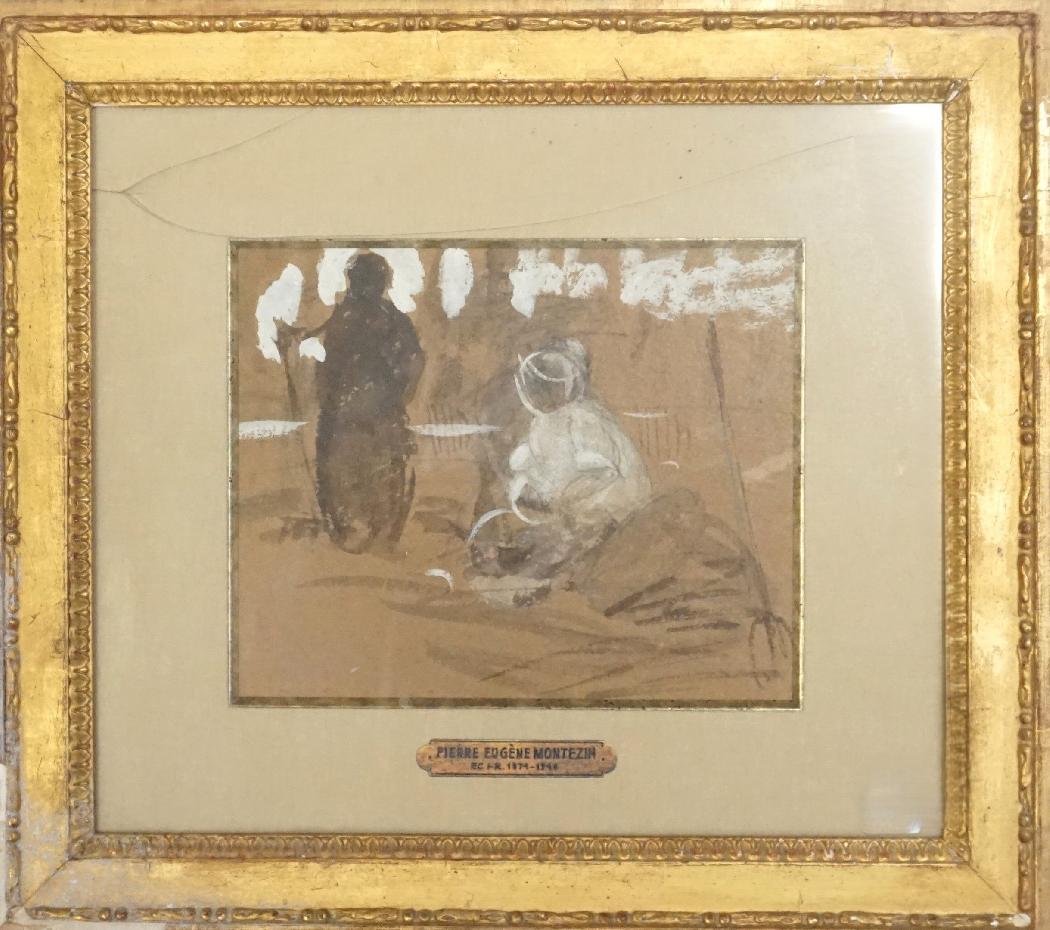
Peasants haymaking – Gouache – 17 x 21 cm
Eugène MONTEZIN (1873 - 1946)Dimensions with frame: 36.5 x 40 cm.
| Type | Gouache, mixed technique |
|---|---|
| Signature | Certificate |
| Size | 17 x 21 cm |
Enquire about the price with the gallery. No online payment.

Other views
Dimensions with frame: 36.5 x 40 cm.
| Type | Gouache, mixed technique |
|---|---|
| Signature | Certificate |
| Size | 17 x 21 cm |
Enquire about the price with the gallery. No online payment.
Artist bio
Pierre Eugène Montézin (born 16 October 1874 in the 10th arrondissement of Paris; died 10 July 1946 in Moëlan-sur-Mer) was a French Post-Impressionist painter influenced by Claude Monet.
Biography Pierre Eugène Montézin was born into a wealthy family. His father was a lace designer who created his own patterns, which were very successful at a time when the lace trade was flourishing. He enjoyed hunting and fishing, which often took him far from Paris. All his free time was devoted to hiking, which was often a veritable countryside expedition.
When Pierre Eugène was attending primary school, his father apprenticed him to a decorating firm.
At 17, he worked decorating panels with flowers and original ornaments. He also painted in oils and eventually gave up decorating to focus solely on painting, particularly landscapes.
In 1893, Pierre Montézin was determined to gain acceptance at the Salon des Artistes Français. He began a ten-year period during which he regularly submitted canvases, all of which were rejected. He then briefly attended the École Bernard-Palissy. During these ten years, he painted Paris and its surroundings tirelessly, and the Salon des Artistes Français finally accepted him into its circle.
In 1914, although exempt from military service, he enlisted and fought on the front lines. He received the Military Medal after the battles in the Meuse.
He returned to France and settled in Paris in 1919. By then, he was married and living with his family.
He moved to Neuilly-sur-Seine with his wife and daughter in 1924 and divided his time between working in his studio and spending time in Veneux-les-Sablons, where he owned a house which he decorated with frescoes.
In 1933, he was unanimously elected president of the jury for the Salon des Artistes Français. At the inaugural ceremony, 237 canvases were exhibited. He exhibited in 1936 at the Galerie du Journal on the Avenue des Champs-Élysées, in 1938 at the Galerie Durand-Ruel on the Avenue de Friedland, and in 1943 at the Galerie Raphaël Gérard.
He was elected to the Académie des Beaux-Arts in 1941, to seat number 1, succeeding Édouard Vuillard, who had died in 1940.
He died suddenly at the age of 71 on July 10, 1946, during a work trip to Brittany. He was found by the side of a road with a box of paints and a few canvases.
Awards and distinctions Awards: medal at the Salon des Artistes Français, 1907 and 1910; Medal of Honour, 1932; Rosa-Bonheur Prize, 1920.
Distinctions 1914-1918 - Military Medal 1923 - Knight of the Legion of Honor, Officer in 1933[2] 1933 - Unanimously elected President of the Salon des Artistes Français 1937 - Elected member of the jury of the International Salon Art et Technique 1941 - Elected member of the Institut de France 1942 - Vice-President of the Board of Directors of the Jean-Jacques Henner National Museum 1943 - President of the Board of Directors of the Jean-Jacques Henner National Museum Works Bordeaux Museum of Fine Arts of Bordeaux: Landscape, oil on canvas, 60 × 80 cm[3]; Chambéry Courthouse: Field Work - Justice and Law, mural in the Hall of Lost Steps[4],[5]; Dijon Museum of Fine Arts: Beginning of the Flood, oil on cardboard, 46 × 73 cm[6]; Dreux Museum of Art and History:
Haymaking in Normandy, oil on canvas, 135 × 130 cm[7],[8]; The White Merle Mill at Saint-Germain-sur-Avre, oil on canvas, 60 × 73 cm (inv. 956.010.001)[9].
Paris National Museum of Modern Art: Haymaking in Normandy; Petit Palais Museum: The Poplars Source: Wikipedia
Rooms
Customize