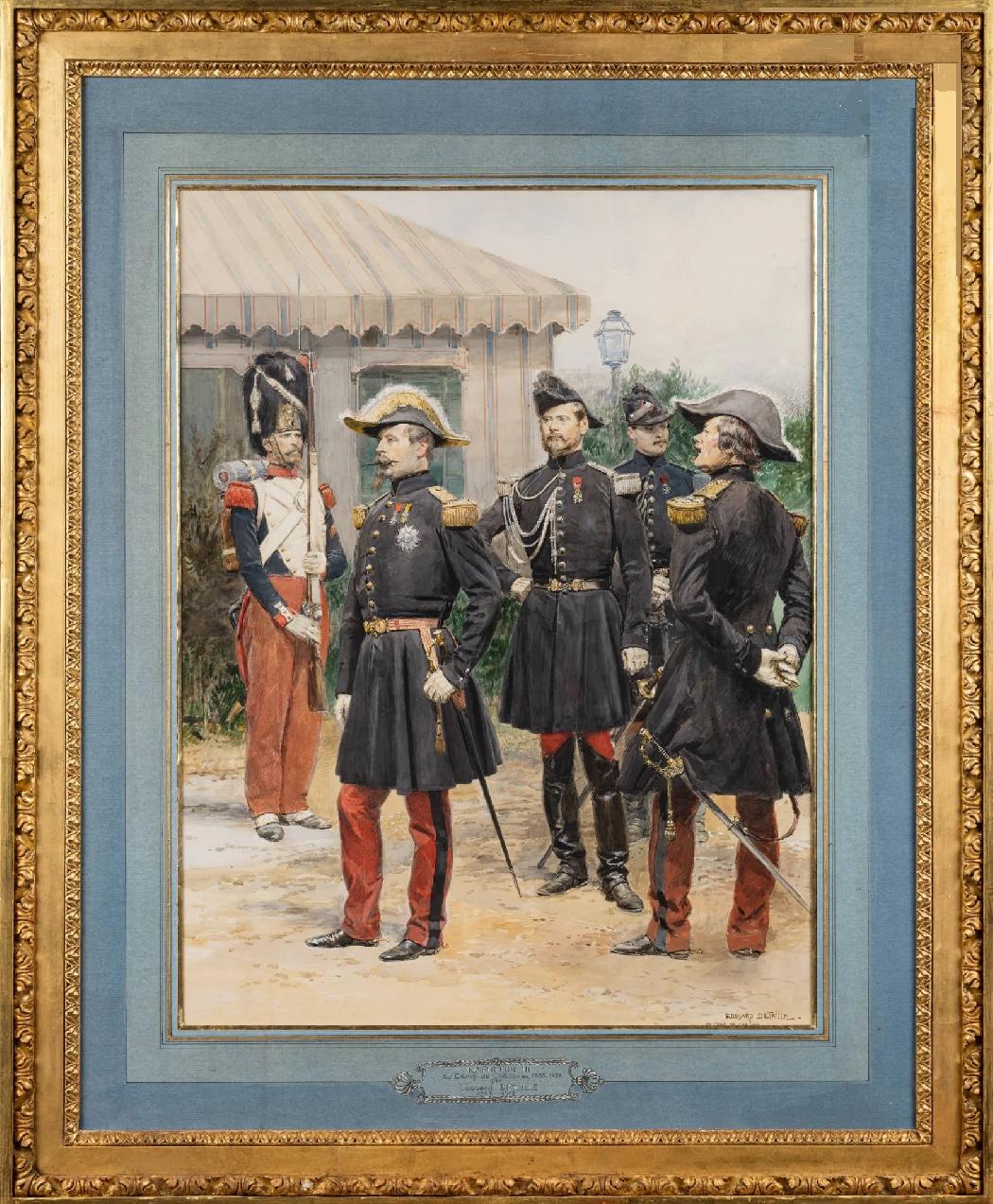
Artist bio
A Genius Born in 1848 in a fairly rich and large family, Edouard Detaille was the eldest of eight children. Since his childhood he had shown facilities at drawings. "He was a gifted kid", said François Robichon. At thirteen, he had an amazing facility to draw, a phenomenal sense of composition. His father, a friend of Horace Vernet, was determined of it. At the age of seventeen, his highschool degree in hand, he started to study at Ernest Meissonier's studio in Poissy. This partnership resulted in a reciprocal affection. Thus, Edouard Detaille had the option to disregard any studies at an Art School also called "Ecole des Beaux-Arts". As for the teaching, rather than dictate an art called "official" Meissonier, already at the top of his fame, traveled with his students to Brussels and Lille.
In 1867, as Paris embrased the free trade world with the Exposition Universelle, the young man was discovering the Salon of the Imperatrice Mathilde and the Dumas's son theater. He knew and was confident of his talent, and was determined to climb the ladder to reach the circle of the most powerfull people without loosing his freedom.
His first painting took part of the exposition of 1868 and was called "La Halte des Tambourgs". Princesse Mathilde acquired it for its beauty and simplicity of the subject. She was the cousin of the Empereur Napoleon. Detaille was not even 20 years old and was already becoming a successfull. He started to be known by a cicrle of artist like Sainte-Beuve, Theophile Gautier, the Goncourt brothers and Flaubert.
His humanist vision was more sensitive than that of his ancestors.
His paintings showed soldiers on the field doing their duties and exercise.
The vision of a soldier While Paris was under siege in 1870, Detaille lost 2 brothers. Certainly influenced by that, from 1871 and on he did not hide the cruaulty of the war in his representaitons.
This artist remembered what Meissonier taught when in his studio:
Nature, nature and always the nature. He also remembered the teaching of Corot, Courbet and Manet who taught him the same.
After living rue Legendre from 1872 to 1875, he built his own house or "hotel particulier" at age 26. The adress was 129 Blvd Malheserbe in Paris. There, he could receive some well known people such as Valtesse de la Bigne.
A great diplomat With his fame increasing over the years, his House was the place where many foreign prince and princess met regularly.
Invited at The Castle of Windsor, he became a personal friend of the Tsar Alexandre III a great friend of Felix Faure.
He won several medals and "The Dream" exposed at the Musee d'Orsay in Paris received the price of Honor in 1899.
His willingness to transform his house into a Museum "Musee Detaille" after his death did not occur even though he left everything to the state.
Howver, Detaille, partly founder of the actual Musee de l'Armee, has many of his works exposed there.
He died on December 24th 1912, at his home.