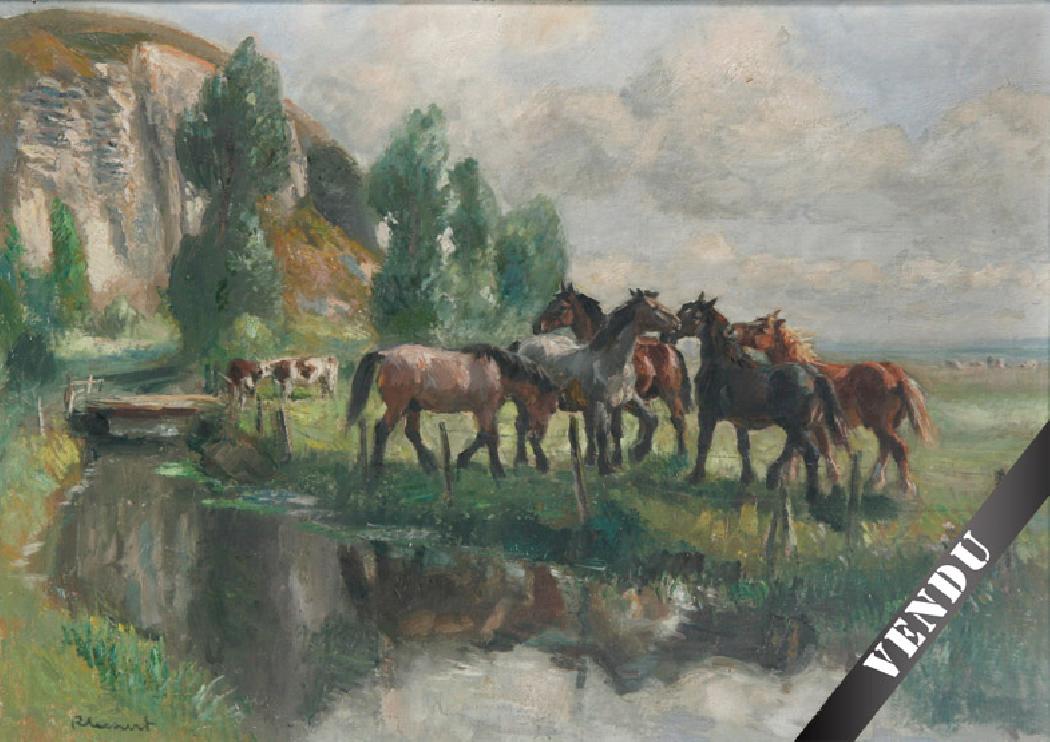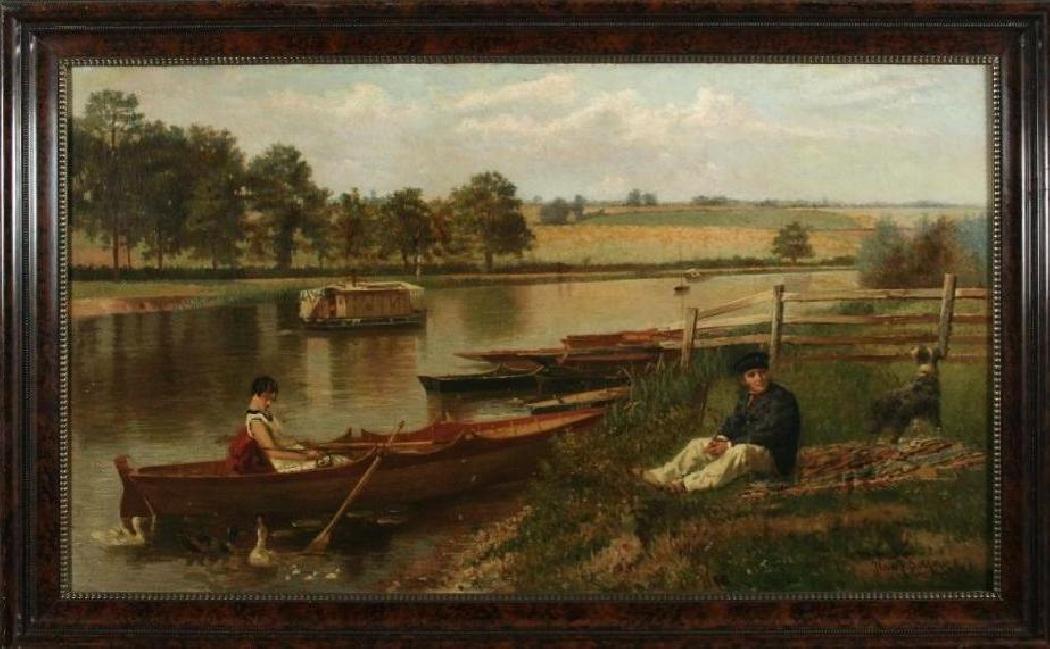
Other views
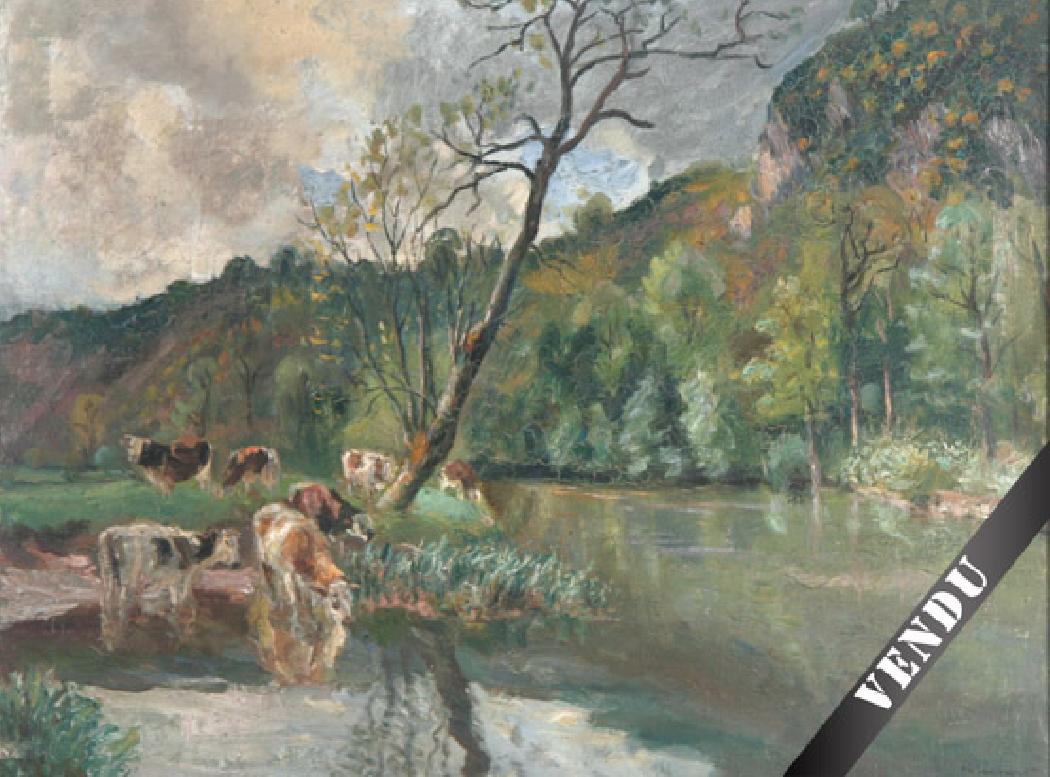
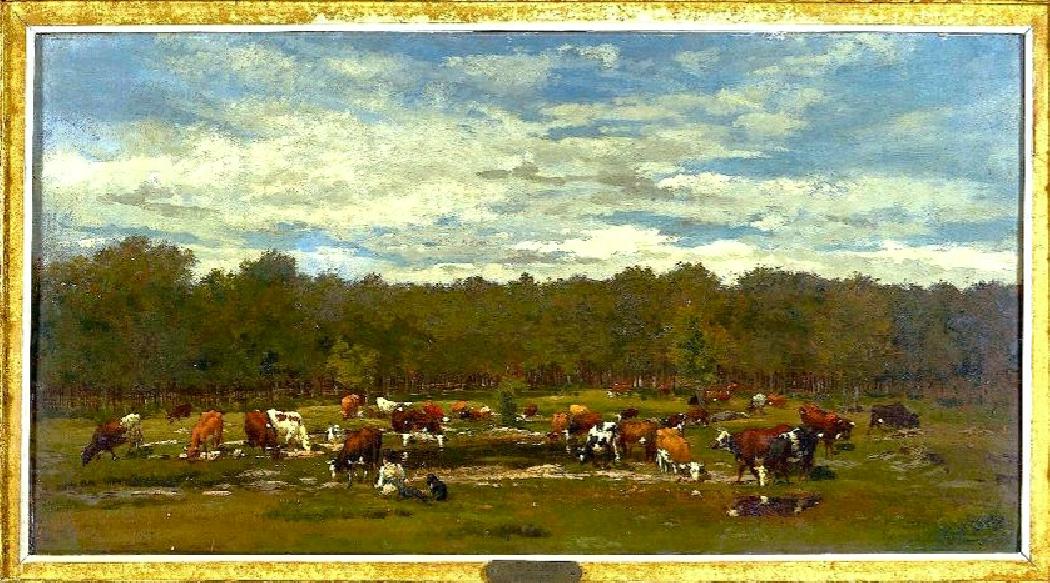
Landscape with cows and washerin women. O/W 68.5 x 38.5 cm
Charles François DAUBIGNY 1817-1878| Type | Oil on board |
|---|---|
| Signature | Lower center |
| Size | 68.5 cm X 38.5 cm |
Price on request
Enquire about the price with the gallery. No online payment.


Other views
| Type | Oil on board |
|---|---|
| Signature | Lower center |
| Size | 68.5 cm X 38.5 cm |
Price on request
Enquire about the price with the gallery. No online payment.
Artist bio
In 1848, Charles-François received a second class medal for one of his paintings exhibited at the Salon. The first class medals go to Corot and Delacroix.
Then he received his first order from the State: an etching. A few years later, in 1852, when he was increasingly noticed at the Salon, the State bought two paintings from him. One of them, “La Moisson”, is now at the Musée d’Orsay.
Charles-François Daubigny then fortuitously met Corot, whom he only knew through his work, and the understanding was immediate although the latter was almost twenty years his senior.
In 1853 Charles-François and Marie-Sophie had their third child, Bernard.
Rewarded by numerous prizes and medals, Charles-François sees his work increasingly appreciated. But it is also contested by certain critics who find it too approximate.
The Workshop Boat In 1857, to be even closer to the motif and the water that he so loved to represent, Daubigny bought a boat, which formerly served as a ferry: the “Botin”. He had a cabin built there so he could take shelter there and, if necessary, sleep there. This will become his Workshop Boat*.
Every summer, he goes to Auvers-sur-Oise, a peaceful place not far from Valmondois, where he spent part of his earliest childhood. He made the Ile de Vaux his main home port. With the “Botin” he travels the rivers and even goes as far as Honfleur. Karl, “the boy”, accompanies him. Then, after several stays in Normandy on the Côte Fleurie, he decided to return to Auvers-sur-Oise, to settle there.
His notoriety grew and Napoleon III bought his painting “Etang de Gylieu” from him, recognized as a pure masterpiece. We are now in 1860.
*Several years later, in 1873, Monet borrowed this idea from Daubigny and he also had a workshop boat built.
Le Botin, sketch Le Botin, sketch The first artistic center of Auvers-sur-Oise The House-Atelier - Painting by Léonide Bourges - Private collection The House-Atelier - Painting by Léonide Bourges - Private collection That same year (1860) Charles-François Daubigny bought land in Auvers to establish his “workshop in the countryside”. He is increasingly interested in the play of light.
In 1861 the first artistic center of Auvers-sur-Oise was built. The Maison-Atelier in Daubigny quickly becomes an opportunity for meetings and work. Daubigny has many students.
Also his close friends (Oudinot, Corot, Daumier, Geoffroy Dechaume, etc.) manage to convince him to decorate this magical place and everyone gets involved. Corot, designer of the Atelier's decoration, will represent Italian landscapes that he also really liked.
Over time the “Botin” takes on more and more water, then retreats. He ends his days in the garden of the Maison-Atelier, as a refreshment bar and shelter. It will be replaced by the “Bottom”, more spacious and better equipped for navigation. This new boat was operational in 1868*. At this moment Bernard becomes the cabin boy, while Karl is promoted to captain!
* The models of the two boats were made by the descendant of Charles-François, Daniel Raskin. They are exhibited from time to time at the Maison-Atelier de Daubigny The defender of art nouveau, and faithful friend From 1866, Charles-François Daubigny supported - with his friend Corot - the artists of the new school, such as Cézanne and Renoir. But he will not succeed in getting them admitted to the Salon. That same year he went to England where he exhibited two paintings at the “Royal Academy”.
In 1868, Charles-François Daubigny succeeded in imposing Monet, Pissarro, Renoir, Degas, Sisley and Berthe Morisot, triggering the anger of the Superintendent of Fine Arts. Monet and Sisley being refused at the Salons of 1869 and 1870, Daubigny followed by his friend Corot resigned from the jury.
Daubigny reached England in 1870 during the war. The news is not good; French artists who had taken refuge in London found themselves in dire straits. Daubigny, by chance, comes across Monet and gets him out of trouble. Soon Pissarro will also find comfort. The art dealer, Durand Ruel, will indeed manage to sell some of his paintings.
At the end of the war of 1870, the Daubigny family returned to France and stayed in different communes before reaching Paris.
The Salon, suspended during the war, resumes and Charles-François Daubigny exhibits two paintings which will be sold there.
After a trip to Holland in 1871, he welcomed Monet and Pissarro with open arms to his house in Auvers-sur-Oise, as well as other young talents, such as Cézanne who arrived in Auvers in 1872.
The last years Snow, Musée d'Orsay - Paris - France During the Salon in 1873 Daubigny won a big prize thanks to his painting “La Neige” today at the Musée d’Orsay, despite fairly harsh criticism. These criticisms are reminiscent of those made a few years later against the Impressionists. Today, Daubigny is considered to be the major precursor of the movement that is Impressionism.
“…I will cite another painting by Daubigny, Snow, which was at the painting exhibition of 1872. We could not imagine anything simpler and at the same time broader. The fields are white with snow; a path crosses them, bordered on the right and left by apple trees with gnarled branches. And on this white sheet, on the fields and on the trees, a whole enormous flock of crows descended, black dots, motionless and whirling. The whole of winter is here before us. In my life, I have never seen anything more melancholic; Daubigny's brush, delicate rather than powerful, this time acquired exceptional strength to render the bleak view of our plains in December. "Emile Zola His disappearance As the years passed, he suffered health problems. However, he does not abandon his escapades aboard the “Bottin”. Back in Auvers-sur-Oise he bought another house, near the station, but would never live there.
Increasingly tired, he undertook a final cruise in the company of his two sons, towards Rouen. He returned to his friends in Auvers and when winter arrived, he worked in his workshop in Paris.
Suffering from a heart attack, he died on February 19, 1878.
Buried in the Père Lachaise cemetery in Paris, he rests next to Corot, his lifelong friend. Geoffroy-Dechaume sculpted his bust in marble which still adorns his tomb. Daumier is not very far from them. They had expressed the desire to be buried close to each other so that they could continue laughing together...
“My uncle told me that Daubigny is dead. It made me sad, I admit it without shame,… It must be a good thing to be aware when dying of having done really good things , to know that, thanks to this, we will remain alive in the memory of at least some, and to leave a good example to those who follow us."
Vincent Van GOGH, letter to Théo, 1878.
Caveau de Daubigny (right), next to Corot. Père Lachaise Cemetery - Paris - France
Rooms
Customize