Artist bio
His father, the theater painter and decorator Charles Laloue, married Marie Eudoxie Lambert at Les Batignolles in Paris on December 29, 1853. Eugène Gallien1 Laloue was born on December 11 of the following year in Montmartre, rue Léonie. He was baptized the following January in the parish of Saint-Pierre de Montmartre.
He was a pupil of Léon Germain Pelouse (1838-1891), a painter from the Barbizon School, from whom he was influenced but not a member.
After the death of his father in 1870, he had to leave school to look for work, being the eldest of nine boys. His mother placed him with a notary. Cheating on his age, he enlisted for the 1870 war. In 1874, living on rue de Clignancourt, he was recruited by the Société française des chemins de fer to draw the track layout from Paris to the provincial stations; he took advantage of this to paint the surrounding countryside, then the districts of Paris, for which he produced a considerable number of gouaches, taking care to respect the perspective of the buildings. He varied the tone of the sky, the appearance of the trees and the lighting according to the seasons, animating the scenes with characters, and was particularly fond of the effects of wet sidewalks in rain or snow. His work is also closely linked to the village landscapes of the Ile-de-France countryside. In 1874, he stayed in Fontainebleau, where he painted sunsets and sunrises, as well as scenes of farmyards and farmyards in Samois-sur-Seine, in the company of Charles Jacque and Léon Dupuy, an artist who did not make a career for himself, but whose name Eugène Galien-Laloue took on as a pseudonym, giving him a second life in artistic circles. On the Butte Montmartre, he painted La Foire de Montmartre, Place Pigalle, as well as the Sacré-Coeur construction site. He used many pseudonyms, the most common being L Dupuy, Kerminguy, Lenoir, Galieny and Lievin.
In 1879, he married Flore Bardin (1861-1887), who gave him a son on July 3, 1880, whom they named Fernand. In 1892, he married for the second time his first wife's sister, Ernestine Bardin, who gave him a daughter, Flore Marie Agnès, on February 4, 1893. That same year, he worked at the Bateau-Lavoir, but his solitary nature did not suit the location. When the First World War broke out, he was not mobilized because of his voluntary enlistment in 1870 and his age, but he made numerous drawings and watercolors of military scenes in 1914. His daughter left the family home after her marriage in 1919. Ernestine Bardin died in 1925. He married the third sister of his previous wives, Claire Bardin, in 1930. Widowed again in 1933, he moved in with his daughter Flore in 1935. In 1940, he went into exile in Bordeaux, unable to paint because of a broken arm.
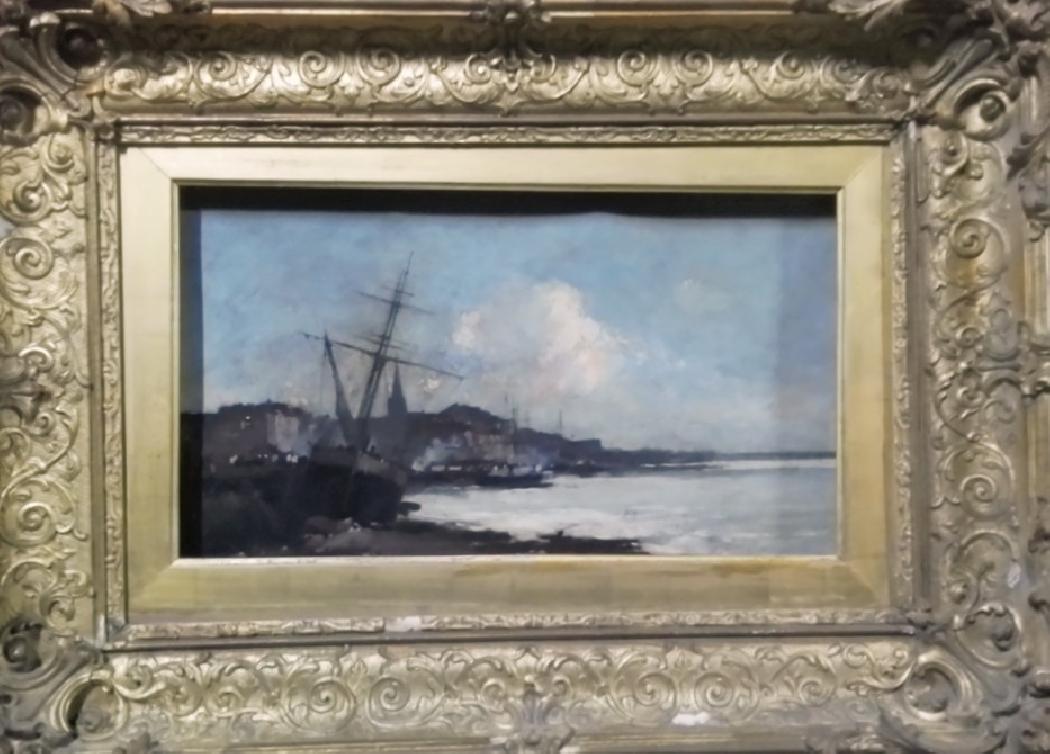
He painted landscapes of Normandy, Seine-et-Marne, Marseille, Italy and Venice. This artist's pictorial output, under his own name or pseudonym, was plethoric, and his commercial success attracted imitators whose pastiches are commonplace on the art market.
He owned two studios in Montmartre: one at 4 rue Ravignan in 1877, and the second at 24 rue Houdon, where he worked in 1886. In 1906, he moved to Fontainebleau.
Eugène Galien-Laloue's grave in the Chérence cemetery He died on April 18, 1941 at his daughter's country home in Chérence (Val-d'Oise), and is buried in the local cemetery.
Salons Salon des artistes français :
1877: two paintings, including En Normandie, and two gouaches; 1878: two paintings; 1879: two paintings; 1887: Les Bords du Loing, gouache; 1889: Bernay; Bords de la Meuse, gouaches; 1904: Boulevard de Bonne-Nouvelle; 1905: La Porte Saint-Denis; 1906: Place Pigalle; 1907: Boulevard Magenta; Église Saint-Médard; 1908: Boulevard de la Madeleine; Boulevard Bonne-Nouvelle; 1909: Place de la Bastille; Porte Saint-Martin; 1911: Quai de l'hôtel de ville; 1914: Flower market at Madeleine.
Exhibitions 1876: Musée des Beaux-Arts de Reims (Quai aux Fleurs, under the snow).
1882: exhibition in Reims.
1907: Saint-Quentin and Angers.
1908: Angers and Toulon.
1909: Angers, Saint-Quentin, Le Havre and Le Mans.
1910: Paris Moderne exhibition (Le Théâtre du Châtelet; Le Quai aux Fleurs).
1911: Angers and Roubaix.
1912: Angers, Bordeaux, Orléans, Saint-Quentin, Versailles, Roubaix and Saint-Étienne.
1913: Monte-Carlo, Haute-Cœur , Nogent-sur-Marne, Geneva and Orléans.
1914: Versailles, Le Puy, Saint-Quentin and Dijon.
Works in public collections United States Huntington (West Virginia), Huntington Museum of Art.
France Paris, Musée Carnavalet: “L'église Saint-Augustin sous la neige”.
Auvers-sur-Oise, Musée Daubigny La Rochelle, Musée des Beaux-Arts.
Louviers, Musée de Louviers.
Mulhouse, Musée des Beaux-Arts.
Reims, Musée des Beaux-Arts.
Wikipedia as the Source