Artist bio
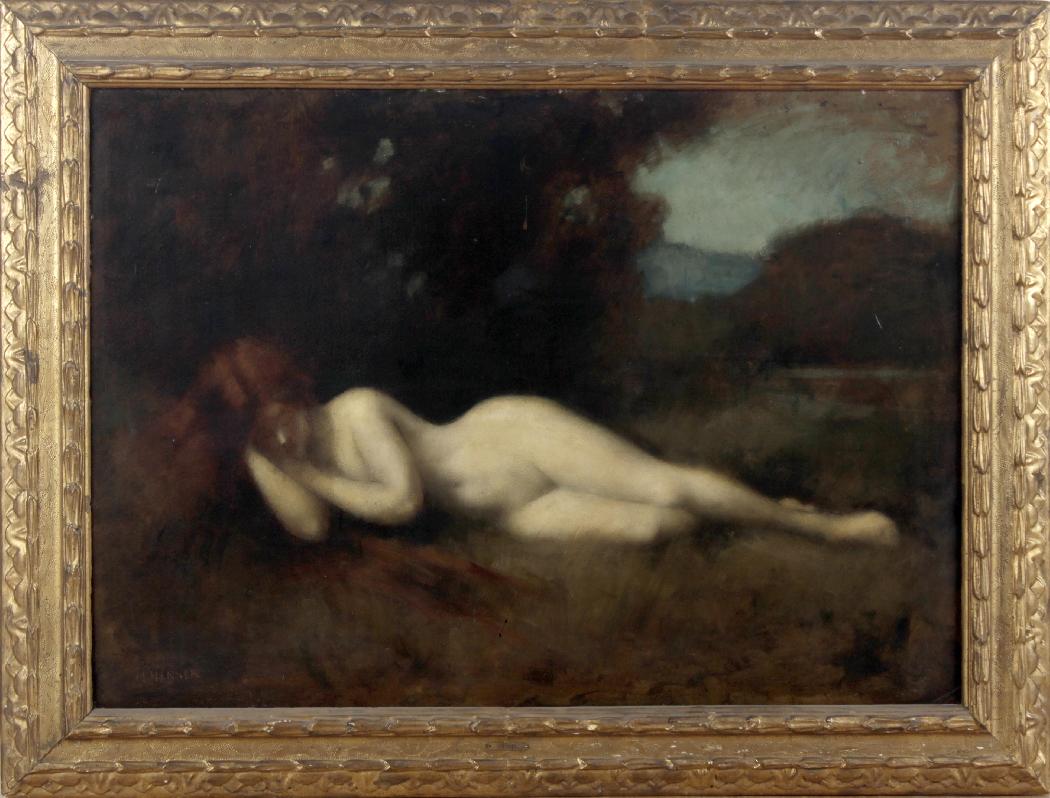
Jean-Jacques Henner was born on March 5, 1829 in Bernwiller, in the south of Alsace, to farmer parents. After the annexation of Alsace by the German Empire in 1871, he opted for French nationality but maintained strong links with his region of origin to which he returned every year. Alsace is very present in his work: in addition to the emblematic Alsace. She waits, he painted numerous landscapes of his native region, including in an idealized form as in Le Rêve or Sleeping Nymph.
His early paintings, mainly portraits and genre scenes such as The Artist's Mother Praying in Front of the Body of Her Daughter Madeleine, are characterized by a realism which will remain a constant in his work. Henner's talent was first noticed by Charles Goutzwiller, his drawing teacher at Altkirch college. He then studied with Gabriel Guérin in Strasbourg. Thanks to financial assistance from the General Council of Haut-Rhin, he continued his studies in Paris, at the École des Beaux-Arts and in the workshops of Drolling and Picot. Henner received traditional training there, which he supplemented with frequent visits to museums. He is especially influenced by Italian Renaissance painting, notably by Titian, Raphael and Correggio. He also appreciates Holbein, of whom he knows The Dead Christ from the Basel Museum, and the French painters of the first half of the 19th century such as Ingres, Prud’hon and Corot.
The Prix de Rome and the stay at the Villa Medici After two failures, Henner won the Grand Prix de Rome for painting in 1858 with Adam and Ėve finding Abel's body. This success allowed him to stay five years in Rome, at the Villa Medici, where he met the sculptor Falguière and the composer Bizet, and opened the doors to an official career. He was inspired by his new living environment with, in 1860, Rome, terrace of the Villa Medici, his only large-format Italian landscape. The painter visited Rome, Florence, Venice, Naples... He admired the works of Antiquity and the Italian Renaissance preserved in the museums but also discovered a country which charmed him with the beauty of its landscapes and the picturesqueness of its daily life . Arriving in Rome as a history painter, he painted numerous genre scenes and luminous small landscapes.
Braun, Henner in academic costume © Henner museum Braun, Henner in academic costume © Henner museum An official career On his return from Rome, the painter temporarily moved towards a naturalism as evidenced by the Portrait of Joseph Tournois, the son of a sculptor friend (Salon of 1864) and the Reclining Woman known as The Woman on a Black Divan from the Salon of 1869 ( Mulhouse, Museum of Fine Arts). Influenced by Manet and Degas, he exhibited La Toilette in 1868, which he destroyed because of unfavorable reviews.
Henner gradually abandons this naturalist style and moves towards subjects coming not from the contemporary world but from an ideal Antiquity without reference to a precise era. Thus, the titles of his paintings evoke the bucolic poems of ancient literature such as Idylle (Paris, Musée d'Orsay) and Éclogue (Paris, Petit Palais), exhibited in 1872 and 1879, or mythology like Byblis (Dijon, Musée des Fine Arts) or Naïade (Paris, Musée d’Orsay).
From the 1870s onwards, the painter became a successful artist and a sought-after portraitist. He was elected to the Institute in 1889 and distinguished, in 1903, with the highest rank in the Order of the Legion of Honor. He regularly sent paintings to the Salons and Universal Exhibitions on historical or religious subjects, therefore belonging to the "great genre" such as Saint Sebastian exhibited at the Salon of 1888. He received few orders apart from La Vérité for the Sorbonne but several from his works were purchased by the State to be exhibited at the Luxembourg Museum, then dedicated to living artists, or sent to major museums in the region. It is also sought after by private collectors such as Alfred Chauchard who owned La Liseuse by Henner but also L'Angélus by Millet, paintings now kept at the Musée d'Orsay.
An academic painter?
In fact, Henner will have an official career filled with honors while his painting does not really correspond to the ideal advocated by the Academy. His history paintings are criticized for their freedom from the traditional treatment of the subject, even though it is at the heart of history painting, the top of the hierarchy of genres. Unlike his contemporary Jean-Paul Laurens or Neo-Greeks like Jean-Léon Gérôme, Henner does not have a taste for historical reconstruction. He gives little importance to elements likely to induce a narrative such as the decor or the costumes, whereas history painting should, for didactic purposes, show examples. His painting also does not have the smooth and precise appearance nor this desire to seduce the viewer whichthis desire to seduce the viewer as evidenced by the works of William Bouguereau or Alexandre Cabanel.
If we cannot truly place Henner in any pictorial movement of the second half of the 19th century, his approach, which combines idealization, realism and reference to the Italian Renaissance, is nevertheless close to that of his sculptor friends, the Neo-Florentines, Paul Dubois and Alexandre Falguière.
When he died in 1905, Henner was a recognized artist whose work was widely disseminated through engraving and photography. Paintings like Alsace. She waits or Fabiola were icons. This success also led to him being widely copied.
Source: Jean Jacques HENNER National Museum